Showing posts with label Farming. Show all posts

Tuesday, 6 November 2012

Cuban Inventor Turns Trash Into Farm Tools


A solitary man trudges through a palm-lined corn field in the Cuban countryside, pulling behind him a rickety contraption that President Raul Castro would love.


The man, Yolando Perez Baez, is showing off his latest invention, a spindly, spider-like piece of equipment that sprays pesticide along six rows of crops, instead of the one row he could dose using his usual backpack fumigator.

With the backpack, Perez says he would have to walk five miles and take six hours to finish the field. The new equipment allows him to do it in one hour and walk less than a mile.

In other words, it fits right in with Castro's quest to cut budget-draining food imports by making Cuban agriculture more efficient and productive.

More than five decades of revolution, and the necessity and isolation that have accompanied it, have made Cubans both skilled at improvisation and a little eccentric, none more so than Perez, 47.

Using parts scrounged from local trash dumps he jokingly calls his "warehouse," Perez has pieced together primitive equipment to spray pesticides, start balky irrigation machinery and speed the harvest of potatoes.

He even wears a hat of his own creation that protects his face from the sun, but looks like a cross between a Chinese peasant hat and something a space alien would wear.

These are not high-tech creations, but, like much else in Cuba, simple and functional, rooted in common sense and the need to make do with what is available. They do not eliminate the back-breaking manual labor that dominates Cuban farm life, but reduce it.

His motor starter is a study in elegant simplicity and addresses a serious need in a country where major equipment tends to be antiquated and often in need of parts that are costly and hard to get.

BROKEN MOTORS

"Eighty percent of the motors here, in this municipality at least, don't have batteries, don't have starters. It's the first thing to break and you have to buy them in hard currency, which is very difficult," Perez said.

So, Perez, an agronomist engineer who wears the stained work clothes of a man that spends a lot of time in the workshop, developed what looks like a small oil rig equipped with a heavy weight.

The weight, tied to a rope that is wrapped around the engine crankshaft, is lifted up by the rig and dropped. The fall pulls the rope and cranks the engine to life.

He has sold eight of the apparatuses for the equivalent of just over $100 each.

One of his customers, Jorge Suarez, praised the machine after it started a massive diesel engine for his irrigation system. As water poured out of a pipe into his cabbage field, he said, "If we don't invent what we invent, then we would be in bad shape. Look, if this man doesn't invent this, I don't know (what we would do)."

Necessity is said to be the mother of invention, but Perez said it was something slightly different.

"The main thing is to be faced with the problem," he said.

Perez works at the "First of May" agricultural cooperative in Guira de Melena, which is about 35 miles west of Havana.

Under reforms by Castro, farmers are making good money, said coop president Jose Miguel Gonzalez said, but only spend it on new equipment when they are convinced it works. The jury was still out on Perez' new fumigator, he said.

Not to worry, said Perez. He has other machines in the works, including a revolving sprinkler system, and, in the end, each invention is just another small step toward a better Cuba.

With "a little that I put here, and another little bit that another Cuban puts there, the economy grows," he said. "The small things have to be noted because sometimes they appear insignificant, but together they are a lot."

Friday, 26 October 2012

Drip Irrigation Offers Huge Savings For Farmers


Three researchers from Batac in Ilocos Norte are developing the low-cost drip irrigation system (LDIS) for rice-based high-value crops such as bitter gourd to meet irrigation requirements in dry environments.


Known for its dry environment, water is a scarce resource in Batac. The periodic rains from June to November are hardly enough to irrigate the crops planted in the province so Engr. Noel Ganotisi, Engr. Romel Batuac, and Dr. Reynaldo Castro of the Philippine Rice Research Institute (PhilRice).

The LDIS uses plastic drum, control valves, filter, mainline and manifold, and lateral lines (moldex hose). It was first used by the team to irrigate a 250-square-meter plot of bitter gourd at a PhilRice station in Batac for the first six months of 2010.

Except for the dripper, all materials are locally available in Batac and elsewhere in the country so anyone could replicate the technology, Ganotisi said.

Ganotisi likewise highlighted that LDIS only costs P30,000, which is up to 72 percent cheaper than commercial irrigation dripping system for a 1,000-square-meter plot.

Ganotisi also reported they were able to save 55 percent of water using LDIS. This amount of water can irrigate other crops, something that could have just been wasted if conventional furrow irrigation was used.

“It’s indeed very efficient. This can be explained by the fact that water was applied “at the root zone of the bitter gourd,” Ganotisi said.

This way, less water is applied “unlike in furrow irrigation where wider area is irrigated since more water is needed to run in furrows. Even those spaces that do not need to be wetted are irrigated when using furrow method.”

Consequently, the team reported that LDIS-irrigated bitter gourd produced slightly higher marketable fruits (78.62 percent) than those irrigated using conventional furrow irrigation (77.02 percent). Additionally, a return on investment of 85 percent over a one year period was reported.
After the station pilot testing, the team started the on-site trial in Currimao, a town in Ilocos Norte.

“This is user-friendly for women and for aging farmers. Once the containers are filled, I only need to turn on and off the drippers and all’s done. I can now focus on my other tasks,” said Agnes Asuncion, who also makes soaps after attending a course from the Department of Science and Technology.

Tuesday, 4 September 2012

Growing Asparagus


Plant once, harvest for years: A well-maintained bed of this sweet, slender veggie will stay productive for up to 15 years, and, with its vibrant, ferny foliage, asparagus makes an excellent ornamental.


Gardeners have been growing asparagus (Asparagus officinalis) for more than 2,000 years, and this sweet, slender veggie’s staying power is no surprise: A well-maintained asparagus bed will start bearing one year after planting and will stay productive for 10 to 15 years.

A hardy perennial adapted in Zones 3 to 8, asparagus grows best in well-drained soil with a near-neutral pH between 6.5 and 7.5. The edible part of the asparagus plant is the young stem shoot, which emerges as soil temperatures rise above 50 degrees Fahrenheit in spring.

Types to Try

Because asparagus stays productive for so long, it’s important to plant the best variety available for your area. In cold climates, ‘Guelph Millennium’ and other varieties that emerge late often escape damage from spring freezes. In warm climates, early, heat-tolerant varieties such as ‘Apollo’ and ‘UC-157’ produce well before the weather turns hot. Gardeners in Zones 4 to 6 have a wider selection of varieties, including ‘Jersey Giant,’ ‘Jersey Knight’ and other hybrids bred in New Jersey for improved disease resistance and better productivity.

When to Plant

Plant asparagus crowns (dormant roots of 1-year-old plants) in spring at about the same time you would plant potatoes, but don’t rush to plant them if your soil is still cold. A few varieties, such as open-pollinated ‘Purple Passion’ and hybrid ‘Sweet Purple,’ can be grown from seed. Start seeds indoors in spring and set out the seedlings when they are 12 to 14 weeks old, just after your last spring frost. Start with asparagus crowns, however, to eliminate the year of tedious weeding that comes with starting from seed.


How to Plant

Choose a site with fertile soil that’s clear of perennial weeds and grasses. A single row of asparagus plants set 15 inches apart will fill in to form a 24- inch-wide bed, or you can grow a double row in a 36-inch-wide bed. Locate asparagus along the back or side of your garden, as 5-foot-tall asparagus fronds will shade any nearby plants. A bed of 25 mature plants will produce about 10 pounds of asparagus per year.

Asparagus craves phosphorus, which is usually abundant in composted manure and in compost made from kitchen waste. Add a 2-inch layer of rich, weed-free compost to your soil before planting. Dig a trench 4 inches deep and 10 inches wide in the amended soil and arrange the crowns in the bottom, about 15 inches apart. Refill the trench without stepping on the bed.

Maintaining Your Bed

Controlling weeds during the first two seasons will require rigorous weeding by hand. Pull out weeds early and often, and mulch with hay, grass clippings or another organic material to suppress weeds and maintain moisture. Weeds will become less of an issue as the plants fill in.

In early winter, after several hard freezes have damaged your asparagus fronds, cut them off and compost them to interrupt the life cycles of insects and diseases. Fertilize the bed with a 1-inch layer of rich, weed-free compost or manure topped with 3 inches of straw, rotted sawdust or another weed-free mulch. Clean spears will push up through the mulch in spring. Fertilize your asparagus again in early summer after you’ve stopped harvesting spears. You can top-dress with a balanced organic fertilizer, or scatter another inch of rich, weed-free compost over the decomposing mulch.

Harvesting and Storage

The exact dates of your spring picking season can vary by two weeks or more because of variations in soil temperature from year to year. Snap off spears longer than 4 inches at the soil line as soon as they appear in spring. As long as a new planting grew vigorously its first season (and your growing season is not extremely short), you can harvest spears for two weeks after your planting is a year old.

The next season, harvest all spears that appear for the first four weeks of active growth. In your third season you can harvest asparagus for six weeks, and by the fourth year the plants will be strong enough to tolerate a full eight-week harvest season.

Promptly refrigerate your harvested asparagus. You can pickle, dry, or blanch and then freeze bumper crops.

Growing Tips and Ideas

Get Psyched for Your Spears. Prepare your bed when you order your asparagus crowns so you can plant them as soon as they arrive.

Choose Male Plants. Most hybrid asparagus varieties are able to produce seven or more spears per mature plant because they are male plants that don’t expend energy producing seeds. However, if you’re growing open-pollinated or hybrid varieties that do include seed-producing female plants, dig out female plants to limit reseeding. Asparagus seedlings are difficult to pull and may become bothersome weeds in some climates.

Tuck Them In. Freezing temperatures ruin asparagus spears, so harvest yours before any harsh spring weather. During the first weeks of the harvest season, covering beds with row cover tunnels held aloft with hoops can help limit damage from the cold.

An Edible Aesthetic. Ferny fronds of asparagus are a beautiful addition to edible landscaping beds, and asparagus stems make great filler material in flower arrangements.

Outsmart Asparagus Beetles

Two species of asparagus beetles damage spears and fronds throughout North America: the common asparagus beetle (black, white and red-orange) and the spotted asparagus beetle (red-orange with black spots), which are both about a third of an inch long.

Asparagus beetles overwinter in plant debris, so removing fronds in winter will reduce their numbers. Lady beetles and several small wasps are major asparagus beetle predators.

Handpick adult asparagus beetles early in the morning when it’s too cool for them to fly. Asparagus beetle eggs look like stubby, brown hairs. Wipe them off of spears with a damp cloth. After they’ve begun feeding on fronds, asparagus beetle larvae (soft, gray, slug-like creatures with black heads) are unable to crawl back up plants if swept off with a broom. Many gardeners allow their poultry to clean up the asparagus bed for three to five days at the end of the harvest season to rid the plot of overwintering adults.

If you have an asparagus beetle problem but don’t have poultry, set aside a section of your asparagus to serve as a spring trap crop. Don’t cut the spears in spring within the plot, but patrol often to collect as many asparagus beetles as you can. In late summer, cut the fronds 2 inches from the ground and compost them. In three weeks or so, you can harvest a fall crop of spears from your trap crop plot.

In the Kitchen

Delicate spears of asparagus are welcome at every meal. For breakfast, asparagus pairs beautifully with bacon, eggs, ham or melon. Layer lightly steamed spears onto lunch sandwiches, or incorporate them into pasta salads, quiches or bread puddings. Asparagus risotto can round out dinner, or you can serve asparagus roasted, braised or grilled as a side dish.

Asparagus cooks quickly. Toss spears with olive oil, salt and pepper, and then grill for just two to three minutes. You can make roasted asparagus by cooking oiled and seasoned spears in an open pan in an oven at 450 degrees Fahrenheit for eight to 10 minutes.

Asparagus is an excellent source of folacin, a B vitamin that helps keep the circulatory system strong, and it’s a good source of potassium and vitamin C. Claims that asparagus fights cancer are based on its high level of glutathione, a potent antioxidant. Light cooking (such as steaming) for eight to 10 minutes increases the bioavailability of asparagus’ healthful compounds.

Tuesday, 28 August 2012

Health Benefits Of Kumquats


A small round to oval citrus fruit, the kumquat resembles a tiny orange. The kumquat grows on trees that originated in China. It can be found in California, Florida, the Mediterranean countries, China, Japan, Indochina, Indonesia, Israel, Peru, and Brazil.


Varieties

Kumquat hybrids, when crossed with other citrus fruits, include the limequat, lemonquat, orangequat, and the calamondin (a cross with the mandarin orange).

Buying and storing tips

Kumquats are occasionally sold with a decorative stem and leaves attached. Avoid fruits with damaged skin and those that feel soft.

Availability

The peak season for kumquats is November through February.

Preparation, Uses, and Tips

In this fruit, the rind is edible, tender, and sweet, while the flesh can be dry and very tart, compared with oranges. Kumquats are usually eaten raw, as whole fruit, excluding the seeds. They make a striking garnish, especially when used with the leaves still attached. As with other citrus fruit, kumquats can be candied, marinated, prepared as marmalade, added to fruit salad, poached, or preserved whole.

Nutritional Highlights
  • Kumquat (raw), 1 fruit (19g)
  • Calories: 12
  • Protein: 0.17g
  • Carbohydrate: 3.1g
  • Total Fat: 0.02g
  • Fiber: 1.25g
  • *Good source of: Vitamin C (7.1mg)


*Foods that are an “excellent source” of a particular nutrient provide 20% or more of the Recommended Daily Value. Foods that are a “good source” of a particular nutrient provide between 10 and 20% of the Recommended Daily Value.

Health benefits and concerns

Allergies and sensitivities (food and chemical)

A low-allergen diet, also known as an elimination diet, is often recommended to people with suspected food allergies in order to find out if avoiding common allergen foods gives relief from symptoms. This diet eliminates foods and food additives considered to be common allergens, including citrus fruits. Some popular books offer guidance to people who want to attempt this type of diet. Most elimination diets are quite restrictive and increase the likelihood of nutritional deficiencies. A successful elimination diet is usually followed by reintroduction of eliminated foods one at a time, to see which ones are truly allergens for the individual person and therefore need to be eliminated indefinitely. Strict avoidance of allergenic foods for a period of time (usually months or years) sometimes results in the foods no longer causing allergic reactions. Restrictive elimination diets and food reintroduction should be supervised by a qualified healthcare professional.

Hives

Allergy to foods and food additives is a common cause of hives, especially in chronic cases. Citrus fruits are among those foods most commonly reported to trigger hives. Numerous clinical studies demonstrate that diets that are free of foods that commonly trigger allergic reactions typically produce significant reductions in symptoms in 50–75% of people with chronic hives. People with hives should investigate the possibility that food allergies are causing their problem by consulting with a doctor.

Kidney stones

Citric acid is found in citrus fruits and may protect against kidney stone formation. Lemons are the best food source commonly available. One preliminary trial found that drinking 2 liters (approximately 2 quarts) of lemonade per day improved the quality of the urine in ways that are associated with stone prevention. Lemonade was far more effective than orange juice. The lemonade was made by mixing 4 oz lemon juice with enough water to make 2 liters. The smallest amount of sweetener possible should be added to make the taste acceptable. Further study is necessary, however, to determine if lemonade can prevent recurrence of kidney stones.

Saturday, 18 August 2012

Food Combination Of Fruits For Better Digestion


The greatest benefits from foods and the most efficient digestion come from simple meals with minimal food combinations. Thus, the first principle of Food Combining is simplicity and compatibility in meal planning.

Fruits digest best when eaten by themselves as an entire meal. In general, fruits should not be eaten with other foods. If they are, they will be detained in the stomach causing them to begin formation.

Alcohol, coffee, tea, vinegar, condiments retard digestion considerably.

Acid Fruits & nuts - Cheeses are ok because the high fat content of nuts & cheeses acts like a separate meal from the Acid frutis by digesting more slowly.

Acid fruits delay the digestion of sweet fruits.

Tomatoes - May be combined with Low Starch vegetables and either avocados or nuts, and not with starches or proteins.

Sugar & Protein - Fruit & other sugars inhibit gastric juice delaying protein digestion

Melons - Because they decompose even faster than the other fruits. It is advised to eat melons separately from other fuits.

Avocados combine BEST with non starchy vegetables. FAIR with acid fruits & starches. Avocados do not combine well with sweet fruits or proteins.

Tuesday, 24 July 2012

The Female Face Of Farming: Infographic


Water - Every Drop Counts


After air, the next most vital thing for our survival is water. While at the moment we have enough water for our needs, a time is likely to come when our water supply runs out and we have to buy water at a price similar to fuel. The solution, which some people have implemented, is to save and store rainwater


Wednesday, 18 July 2012

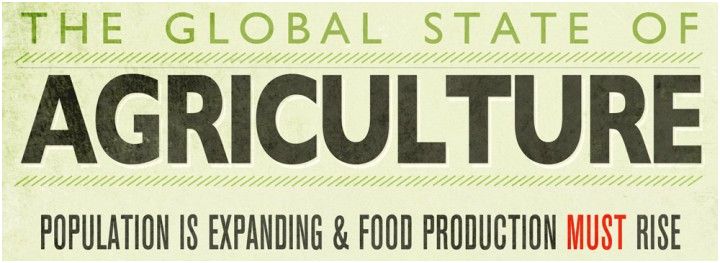
The Global State of Agriculture


The U.S. humanitarian assistance organization provides this infographic to illustrate the need for increased food production by emphasizing the boom in the global population. The planet now supports 7 billion people, and USAID estimates food production must increase 70% by 2050 to meet the growing need.


Tuesday, 17 July 2012

The Story Of Agriculture And The Green Economy

The future of our world depends on addressing global challenges now. We need to create sustainable livelihoods, feed a growing population and safeguard the environment. We need to make the global economy green.


Monday, 16 July 2012

Can Organic Agriculture Feed A World Of Nine Billion People?


A new meta-analysis suggests farmers should take a hybrid approach to producing enough food for humans while preserving the environment.

Agriculture has supplanted 70 percent of grasslands, 50 percent of savannas and 45 percent of temperate forests as a result of global climate changes. Modern commercial farming is also the leading cause of deforestation in the tropics and one of the largest sources of greenhouse gas emissions, a major contributor to the ongoing maul of species known as the “sixth extinction,” and a perennial source of nonrenewable groundwater mining and water pollution.

To restrain the environmental impact of agriculture as well as produce more wholesome foods, some farmers have turned to so-called organic techniques. This type of farming is meant to minimize environmental and human health impacts by avoiding the use of synthetic fertilizers, chemical pesticides and hormones or antibiotic treatments for livestock, among other tactics. But the use of industrial technologies, particularly synthetic nitrogen fertilizer, has fed the swelling human population during the last century. Can organic agriculture feed a world of nine billion people?

Environmental scientists at McGill University in Montreal and the University of Minnesota performed an analysis of 66 studies comparing conventional and organic methods across 34 different crop species. They found that, overall, organic yields are considerably lower than conventional yields but, this yield difference varies across different conditions. When farmers apply best management practices, organic systems, for example, perform relatively better.

In particular, organic agriculture delivers just 5 percent less yield in rain-watered legume crops, such as alfalfa or beans, and in perennial crops, such as fruit trees. But when it comes to major cereal crops, such as corn or wheat, and vegetables, such as broccoli, conventional methods delivered more than 25 percent more yield. But that is quantity, not quality.


The key limit to further yield increases via organic methods appears to be nitrogen – large doses of synthetic fertilizer can keep up with high demand from crops during the growing season better than the slow release from compost, manure or nitrogen-fixing cover crops. Of course, the cost of using 171 million metric tons of synthetic nitrogen fertilizer is paid in dead zones at the mouths of many of the world’s rivers. These anoxic zones result from nitrogen-rich runoff promoting algal blooms that then die and, in decomposing, suck all the oxygen out of surrounding waters.

To address the problem of nitrogen limitation and to produce high yields, organic farmers should use best management practices, supply more organic fertilizers or grow legumes or perennial crops.

In fact, more knowledge would be key to any effort to boost organic farming or its yields. Conventional farming requires knowledge of how to manage what farmers know as inputs – synthetic fertilizer, chemical pesticides and the like – as well as fields laid out precisely via global-positioning systems. Organic farmers, on the other hand, must learn to manage an entire ecosystem geared to producing food – controlling pests through biological means, using the waste from animals to fertilize fields and even growing one crop amidst another.

Organic farming is a very knowledge-intensive farming system. An organic farmer “needs to create a fertile soil that provides sufficient nutrients at the right time when the crops need them. 

 Source: Scientific American

Featured image credit: Chillymanjaro


Sunday, 15 July 2012

Hybrid Farming A Good Investment


The higher cost of producing hybrid rice is offset by the higher yields and income the farmers get, according to Dr. Frisco Malabanan, director of the Ginintuang Masaganang Ani (GMA) rice program of the Department of Agriculture (DA).


“The use of hybrid seeds has tremendously increased our palay production by 1.47 metric tons (MT) per hectare, with per hectare yields hitting 6.01 MT against the 4.5 MT average produced by farmers using the inbred rice variety,” he said.

The DA official said the hybrid rice varieties have recorded a yield advantage of 33 percent more than those on inbred certified seeds. The yield advantage, he said, contributed to a sustained increase in the national palay production of the country.

He said in many provinces in the country, especially in Nueva Ecija, more and more farmers are now planting high-yielding hybrid rice seed variety and using the latest farming technology.

Henry Lim, chairman and chief executive officer (CEO) of SL Agritech Corp., the country’s top producer of hybrid rice seeds, said “hamak laki na ng inaani ngayon ng mga farmers sa Nueva Ecija na nagtatanim ng hybrid seed variety than before when they were planting the traditional or inbred rice variety and were not working as a group.”

He said the Bagong Buhay Multi-Purpose Cooperative (BBMPC) in Barangay Mabini in Sto. Domingo, Nueva Ecija, a cluster of 200 hectares, is one example where working together as a group or common sharing of resources, will have tremendous effect to increase production.

BBMPC has been named by the Department of Agriculture as a “model hybrid rice cluster” as its farmer-members have been posting an average harvest of 180 cavans or 10.09 metric tons (MY) per hectare using the SL-8H hybrid rice variety.

Lim at the same time commended the members of the BBMPC who, he said, “are receptive in adopting modern farm technologies and practices.”

He said that while “we are all aware of the important role played by technology in our massive food production efforts, there is the apparent need for all of us to keep abreast with the various technological approaches and to continuously be in search of new and better systems towards increase productivity.”

Thursday, 12 July 2012

Will The World Go Hungry?


In the first half of this century, as the world’s population grows to around 9 billion, global demand for food, feed and fiber will nearly double while, increasingly, crops may also be used for bio-energy and other industrial purposes. New and traditional demand for agricultural produce will thus put growing pressure on already scarce agricultural resources. And while agriculture will be forced to compete for land and water with sprawling urban settlements, it will also be required to serve on other major fronts: adapting to and contributing to the mitigation of climate change, helping preserve natural habitats, protecting endangered species and maintaining a high level of biodiversity. As though this were not challenging enough, in most regions fewer people will be living in rural areas and even fewer will be farmers. They will need new technologies to grow more from less land, with fewer hands.