Showing posts with label Resources. Show all posts

Tuesday, 28 August 2012

Health Benefits Of Kumquats


A small round to oval citrus fruit, the kumquat resembles a tiny orange. The kumquat grows on trees that originated in China. It can be found in California, Florida, the Mediterranean countries, China, Japan, Indochina, Indonesia, Israel, Peru, and Brazil.


Varieties

Kumquat hybrids, when crossed with other citrus fruits, include the limequat, lemonquat, orangequat, and the calamondin (a cross with the mandarin orange).

Buying and storing tips

Kumquats are occasionally sold with a decorative stem and leaves attached. Avoid fruits with damaged skin and those that feel soft.

Availability

The peak season for kumquats is November through February.

Preparation, Uses, and Tips

In this fruit, the rind is edible, tender, and sweet, while the flesh can be dry and very tart, compared with oranges. Kumquats are usually eaten raw, as whole fruit, excluding the seeds. They make a striking garnish, especially when used with the leaves still attached. As with other citrus fruit, kumquats can be candied, marinated, prepared as marmalade, added to fruit salad, poached, or preserved whole.

Nutritional Highlights
  • Kumquat (raw), 1 fruit (19g)
  • Calories: 12
  • Protein: 0.17g
  • Carbohydrate: 3.1g
  • Total Fat: 0.02g
  • Fiber: 1.25g
  • *Good source of: Vitamin C (7.1mg)


*Foods that are an “excellent source” of a particular nutrient provide 20% or more of the Recommended Daily Value. Foods that are a “good source” of a particular nutrient provide between 10 and 20% of the Recommended Daily Value.

Health benefits and concerns

Allergies and sensitivities (food and chemical)

A low-allergen diet, also known as an elimination diet, is often recommended to people with suspected food allergies in order to find out if avoiding common allergen foods gives relief from symptoms. This diet eliminates foods and food additives considered to be common allergens, including citrus fruits. Some popular books offer guidance to people who want to attempt this type of diet. Most elimination diets are quite restrictive and increase the likelihood of nutritional deficiencies. A successful elimination diet is usually followed by reintroduction of eliminated foods one at a time, to see which ones are truly allergens for the individual person and therefore need to be eliminated indefinitely. Strict avoidance of allergenic foods for a period of time (usually months or years) sometimes results in the foods no longer causing allergic reactions. Restrictive elimination diets and food reintroduction should be supervised by a qualified healthcare professional.

Hives

Allergy to foods and food additives is a common cause of hives, especially in chronic cases. Citrus fruits are among those foods most commonly reported to trigger hives. Numerous clinical studies demonstrate that diets that are free of foods that commonly trigger allergic reactions typically produce significant reductions in symptoms in 50–75% of people with chronic hives. People with hives should investigate the possibility that food allergies are causing their problem by consulting with a doctor.

Kidney stones

Citric acid is found in citrus fruits and may protect against kidney stone formation. Lemons are the best food source commonly available. One preliminary trial found that drinking 2 liters (approximately 2 quarts) of lemonade per day improved the quality of the urine in ways that are associated with stone prevention. Lemonade was far more effective than orange juice. The lemonade was made by mixing 4 oz lemon juice with enough water to make 2 liters. The smallest amount of sweetener possible should be added to make the taste acceptable. Further study is necessary, however, to determine if lemonade can prevent recurrence of kidney stones.

Tuesday, 24 July 2012

Water - Every Drop Counts


After air, the next most vital thing for our survival is water. While at the moment we have enough water for our needs, a time is likely to come when our water supply runs out and we have to buy water at a price similar to fuel. The solution, which some people have implemented, is to save and store rainwater


Monday, 23 July 2012

More Efficient Renewable Resource.


New biofuel process generates energy 20 times higher than existing methods, and uses agricultural waste:


A new biofuel production process created by Michigan State University researchers produces energy more than 20 times higher than existing methods. The results, published in the current issue of Environmental Science and Technology, showcase a novel way to use microbes to produce bio fuel and hydrogen, all while consuming agricultural wastes.

Gemma Reguera, MSU microbiologist, has developed bioelectrochemical systems known as microbial electrolysis cells, or MECs, using bacteria to breakdown and ferment agricultural waste into ethanol. Reguera's platform is unique because it employs a second bacterium, which, when added to the mix, removes all the waste fermentation byproducts or non-ethanol materials while generating electricity.

Similar microbial fuel cells have been investigated before. However, maximum energy recoveries from corn stover, a common feedstock for biofuels, hover around 3.5 percent. Reguera's platform, despite the energy invested in chemical pretreatment of the corn stover, averaged 35 to 40 percent energy recovery just from the fermentation process, said Reguera, who co-authored the paper with Allison Spears.

"This is because the fermentative bacterium was carefully selected to degrade and ferment agricultural wastes into ethanol efficiently and to produce byproducts that could be metabolized by the electricity-producing bacterium," Reguera said. "By removing the waste products of fermentation, the growth and metabolism of the fermentative bacterium also was stimulated. Basically, each step we take is custom-designed to be optimal."

The second bacterium, Geobacter sulfurreducens, generates electricity. The electricity, however, isn't harvested as an output. It is used to generate hydrogen in the MEC to increase the energy recovery process even more, Reguera said.

"When the MEC generates hydrogen, it actually doubles the energy recoveries," she said. "We increased energy recovery to 73 percent. So the potential is definitely there to make this platform attractive for processing agricultural wastes."

Reguera's fuel cells use corn stover treated by the ammonia fiber expansion process, an advanced pretreatment technology pioneered at MSU. AFEX is an already proven method that was developed by Bruce Dale, MSU professor of chemical engineering and materials science. Dale is currently working to make AFEX viable on a commercial scale.

In a similar vein, Reguera is continuing to optimise her MECs so they, too, can be scaled up on a commercial basis. Her goal is to develop decentralised systems that can help process agricultural wastes. Decentralised systems could be customised at small to medium scales (such as compost bins and small silages, for example) to provide an attractive method to recycle the wastes while generating fuel for farms.

Worldwide, the market for biofuel production is expected to reach $100 billion by 2018, compared to $35 billion just a decade earlier.

Wednesday, 18 July 2012

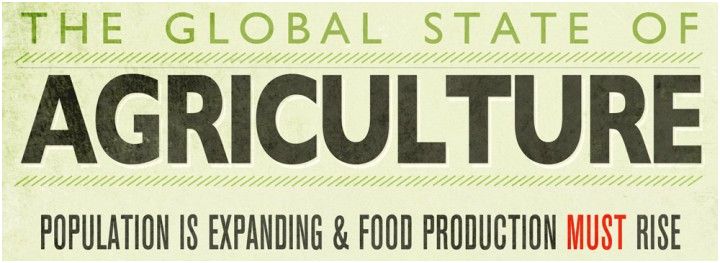
The Global State of Agriculture


The U.S. humanitarian assistance organization provides this infographic to illustrate the need for increased food production by emphasizing the boom in the global population. The planet now supports 7 billion people, and USAID estimates food production must increase 70% by 2050 to meet the growing need.


Monday, 16 July 2012

Can Organic Agriculture Feed A World Of Nine Billion People?


A new meta-analysis suggests farmers should take a hybrid approach to producing enough food for humans while preserving the environment.

Agriculture has supplanted 70 percent of grasslands, 50 percent of savannas and 45 percent of temperate forests as a result of global climate changes. Modern commercial farming is also the leading cause of deforestation in the tropics and one of the largest sources of greenhouse gas emissions, a major contributor to the ongoing maul of species known as the “sixth extinction,” and a perennial source of nonrenewable groundwater mining and water pollution.

To restrain the environmental impact of agriculture as well as produce more wholesome foods, some farmers have turned to so-called organic techniques. This type of farming is meant to minimize environmental and human health impacts by avoiding the use of synthetic fertilizers, chemical pesticides and hormones or antibiotic treatments for livestock, among other tactics. But the use of industrial technologies, particularly synthetic nitrogen fertilizer, has fed the swelling human population during the last century. Can organic agriculture feed a world of nine billion people?

Environmental scientists at McGill University in Montreal and the University of Minnesota performed an analysis of 66 studies comparing conventional and organic methods across 34 different crop species. They found that, overall, organic yields are considerably lower than conventional yields but, this yield difference varies across different conditions. When farmers apply best management practices, organic systems, for example, perform relatively better.

In particular, organic agriculture delivers just 5 percent less yield in rain-watered legume crops, such as alfalfa or beans, and in perennial crops, such as fruit trees. But when it comes to major cereal crops, such as corn or wheat, and vegetables, such as broccoli, conventional methods delivered more than 25 percent more yield. But that is quantity, not quality.


The key limit to further yield increases via organic methods appears to be nitrogen – large doses of synthetic fertilizer can keep up with high demand from crops during the growing season better than the slow release from compost, manure or nitrogen-fixing cover crops. Of course, the cost of using 171 million metric tons of synthetic nitrogen fertilizer is paid in dead zones at the mouths of many of the world’s rivers. These anoxic zones result from nitrogen-rich runoff promoting algal blooms that then die and, in decomposing, suck all the oxygen out of surrounding waters.

To address the problem of nitrogen limitation and to produce high yields, organic farmers should use best management practices, supply more organic fertilizers or grow legumes or perennial crops.

In fact, more knowledge would be key to any effort to boost organic farming or its yields. Conventional farming requires knowledge of how to manage what farmers know as inputs – synthetic fertilizer, chemical pesticides and the like – as well as fields laid out precisely via global-positioning systems. Organic farmers, on the other hand, must learn to manage an entire ecosystem geared to producing food – controlling pests through biological means, using the waste from animals to fertilize fields and even growing one crop amidst another.

Organic farming is a very knowledge-intensive farming system. An organic farmer “needs to create a fertile soil that provides sufficient nutrients at the right time when the crops need them. 

 Source: Scientific American

Featured image credit: Chillymanjaro


Thursday, 12 July 2012

Will The World Go Hungry?


In the first half of this century, as the world’s population grows to around 9 billion, global demand for food, feed and fiber will nearly double while, increasingly, crops may also be used for bio-energy and other industrial purposes. New and traditional demand for agricultural produce will thus put growing pressure on already scarce agricultural resources. And while agriculture will be forced to compete for land and water with sprawling urban settlements, it will also be required to serve on other major fronts: adapting to and contributing to the mitigation of climate change, helping preserve natural habitats, protecting endangered species and maintaining a high level of biodiversity. As though this were not challenging enough, in most regions fewer people will be living in rural areas and even fewer will be farmers. They will need new technologies to grow more from less land, with fewer hands.